How Long Will a 12V Fridge Run on a Battery?
Expect roughly 1 to 3 days on a typical 100Ah lithium battery, depending on the fridge's average amp draw and how much of the battery you can safely use. A 12V fridge averaging about 1.2A draws around 29Ah per day, so a 100Ah lithium battery with about 80Ah usable lasts close to 3 days.
On this page (9 sections)
- How long will a 12V fridge run on battery in everyday numbers?
- What battery capacity do you actually have to work with?
- Why does a 12V fridge run longer in some setups than others?
- How do you calculate your own fridge runtime?
- How should you connect a 12V fridge to the battery safely?
- Which fridge settings stretch a battery the most?
- What changes if the fridge has its own built-in battery?
- How long will a 12V fridge run on battery overnight and over several days?
- How do you get the most fridge runtime from your battery?
Here's the short answer to how long will a 12V fridge run on battery: work from the fridge's average amp draw, not its peak rating. A 12V compressor fridge that averages about 1.2A uses roughly 29Ah per day, so a 100Ah lithium battery with about 80Ah usable gives you close to 3 days.
That's the figure most buyers should plan around. The rest of this guide shows how to get your own number, why real-world runtime often comes in shorter, and which products make the setup easier.
How long will a 12V fridge run on battery in everyday numbers?
Most portable 12V fridges last 1 to 3 days on a single 100Ah battery. The range is wide because a small chest fridge sipping 1A and a large dual-zone freezer pulling 2A or more are very different loads.
Here's the quick math. Take the fridge's average current in amps, multiply by 24 for daily amp-hours, then divide usable battery capacity by that figure.
A fridge at 1A needs 24Ah per day; at 2A it needs 48Ah.
The catch is that "average" matters more than the label. Compressor fridges cycle on and off, so the running current on the spec plate is not the current they draw all day.
Our guide to how many amps does a 12V fridge draw breaks down typical running and average figures by size.
| Fridge average draw | Daily Ah used | Runtime on 80Ah usable lithium |
|---|---|---|
| 1A | 24Ah | About 3.3 days |
| 1.5A | 36Ah | About 2.2 days |
| 2A | 48Ah | About 1.7 days |
| 3A | 72Ah | About 1.1 days |
Treat these as planning figures. Your fridge, climate and packing habits will shift the result.
What battery capacity do you actually have to work with?
Usable capacity is lower than the number printed on the battery. Lithium iron phosphate (LiFePO4) batteries let you use about 80 percent of their rated capacity without harming them.
Lead-acid and AGM batteries should only be drawn to about 50 percent to protect their lifespan.
So a 100Ah lithium battery gives you roughly 80Ah of usable energy. A 100Ah AGM battery gives you about 50Ah.
That difference alone halves your fridge runtime on lead-acid.
If you haven't bought a battery yet, size it from the fridge's daily draw and your longest gap between charges. A weekend camper with no solar might want 100Ah of lithium; a week off-grid needs 200Ah or more, or a solar panel to top up each day.
Why does a 12V fridge run longer in some setups than others?
The same fridge and battery can last twice as long in mild weather with careful habits. Ambient temperature is the biggest swing factor.
A fridge in a 95°F van works far harder than one in a 70°F cabin.
Other factors that shorten runtime:
- Loading warm food or drinks, which forces a long cooling cycle
- Opening the lid often on a chest fridge
- Running the fridge as a freezer, or setting it near its coldest limit
- Parking the fridge in direct sun without ventilation
- A poor connection or undersized cable causing voltage drop
A fridge with good insulation and a tight lid seal holds its temperature between compressor cycles, so it runs less. Packing it full of already-cold food also helps, since a full fridge loses cold more slowly than an empty one.
How do you calculate your own fridge runtime?
Use this formula: usable amp-hours divided by average amps equals hours of runtime. You need two numbers: the battery's usable capacity and the fridge's real average draw.
For the draw, start with the maker's low-power figure. BougeRV says its CR22 23-quart fridge runs at about 45W in ECO mode, which at 12V works out to roughly 3.75A while the compressor is on.
Because the compressor cycles, the 24-hour average lands well below that running figure.
If you have a battery monitor or a clamp meter, measure actual draw over a full day in your usual conditions. That beats any estimate.
When you don't have a meter, assume a slightly higher average than the marketing figure to leave a safety margin.
For the capacity, use 80 percent of a lithium rating or 50 percent of a lead-acid rating. Then divide.
If the result looks short for your trip, add battery capacity or solar rather than pushing the battery lower.
How should you connect a 12V fridge to the battery safely?
Run the fridge on a fused circuit with adequate cable, and let the fridge's low-voltage cutoff protect the battery. A loose or thin connection causes voltage drop, and the fridge sees a lower voltage than the battery really has, so it shuts down early or works harder.
Use the DC cord that came with the fridge where possible. For a longer run to a rear cargo area, a heavier-gauge extension cord keeps the voltage steadier.
The Naubluvo 11.5FT cord is 16 AWG with a 15A fuse and an insulating silicone ring, giving overcurrent and short-circuit protection for a modest load at that length.
If you're wiring from scratch, follow a proper sequence: fuse at the battery, correct polarity, secure connections. Our walkthrough on how to connect a 12V fridge to a battery covers the steps in order.
Never run a fridge from an unfused direct cable, and keep the plug and socket dry.
Which fridge settings stretch a battery the most?
Set the fridge to the warmest temperature that still keeps food safe, and use eco mode. Every degree colder costs energy.
For chilled food, 37°F to 40°F is a sensible target; freezers need far more power.
Most 12V fridges offer a battery protection setting that shuts the compressor off at a chosen voltage. This is your backstop against draining the battery flat.
Our guide to 12V fridge battery protection explains how to pick low, mid or high for your battery type. A lithium battery tolerates a lower cutoff than lead-acid, but either way the cutoff only protects the battery, it doesn't make it last longer.
Other settings that help:
- ECO or low-power mode for everyday chilling
- A freezer set only as cold as you actually need
- Pre-chilling the fridge on mains power before you leave
- Parking in shade and ventilating the compartment
Small fridges help here too. A 23-quart unit holds less warm air and cools faster than a large chest, so its compressor cycles less overall.
What changes if the fridge has its own built-in battery?
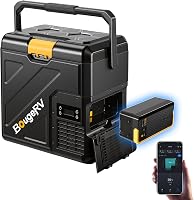
A fridge with an integrated battery runs for hours without touching your main battery. The BougeRV CRH20 pairs a 21-quart fridge with a 240Wh detachable LiFePO4 battery, and BougeRV says the battery delivers up to 30 hours of runtime under certain conditions.
Do the math to sanity-check that claim. A 240Wh battery powering a fridge that averages about 1A at 12V (12W) would run roughly 20 hours.
At a lighter average draw, 30 hours is plausible. Either way, the built-in battery is a buffer, not a replacement for a larger house battery on a long trip.
The advantage is flexibility. You can carry the CRH20 to a picnic or a campsite without wiring it to the vehicle, then recharge the detachable battery from a DC socket or mains power.
The catch is capacity: 240Wh is smaller than a 100Ah lithium battery, so it suits day trips and short overnights better than a week off-grid.
How long will a 12V fridge run on battery overnight and over several days?
Overnight, almost any decent battery copes; the multi-day stretch is where planning pays off. A fridge averaging 1.2A uses about 10Ah across an eight-hour night, which a 50Ah usable battery handles easily.
Three cloudy days without solar is the harder test, since the battery gets no recharge.
If you're relying on the vehicle's alternator, you'll only recharge while driving. A DC-to-DC charger speeds that up, but it still needs engine run time.
Solar is the better answer for stationary camping: a 100W to 200W panel, angled toward the sun, can cover a small fridge's daily draw in good weather.
When should you skip the deep-cycle battery and use the car's starter battery?
Only for short stops. A car battery has limited usable capacity, and running a fridge from it for days risks a flat battery when you need to start the engine.
Our post on how long will a car battery run a 12V fridge sets out the realistic limits. For camping, a dedicated deep-cycle or lithium battery is the safer choice.
How do you get the most fridge runtime from your battery?
Start with the right battery, connect it properly, then manage the load. For most campers, that means a 100Ah lithium battery, a fused DC connection and a fridge set to eco mode in a shaded spot.
Pick a lithium battery if you want the longest runtime for the size and weight. Pick a fridge with a built-in battery if you need portability for day trips rather than week-long off-grid stays.
Pick a larger battery or add solar if your trips regularly run past three days without driving.
To estimate your own how long will 12v fridge run on battery figure, use the formula, measure your average draw once, and leave a safety margin. If you're still deciding on a fridge size, match the wattage to your battery, and if you're wiring the setup, start with a proper fused connection and a sensible battery cutoff.
The realistic answer for most setups is two to three days on a 100Ah lithium battery, less on lead-acid and more with solar. Plan around that figure and the fridge becomes one less thing to worry about.
Frequently asked questions
Does a 12V fridge run all night on a battery?
Yes. Overnight is the easy part, since the fridge cycles less in cooler night air and draws roughly 10 to 15Ah over eight hours.
The harder test is several cloudy days without solar, when the battery has no way to recharge.
What drains a 12V fridge battery faster?
Hot weather, a fridge packed with warm food, frequent lid openings and a freezer set well below freezing all raise the average draw. A fridge in direct sun works harder too, so park in shade or ventilate the compartment.
Can I run a 12V fridge from my car's starter battery?
You can for short stops, but not for days. A starter battery is built for brief high-current bursts and has limited usable capacity, so a long fridge run risks a flat battery.
Pair a dedicated deep-cycle or lithium battery with the fridge instead.